Human-in-the-Loop: Where AI Systems Still Need People
Full automation is not the goal. The systems that hold up in production are the ones that figured out where humans belong.
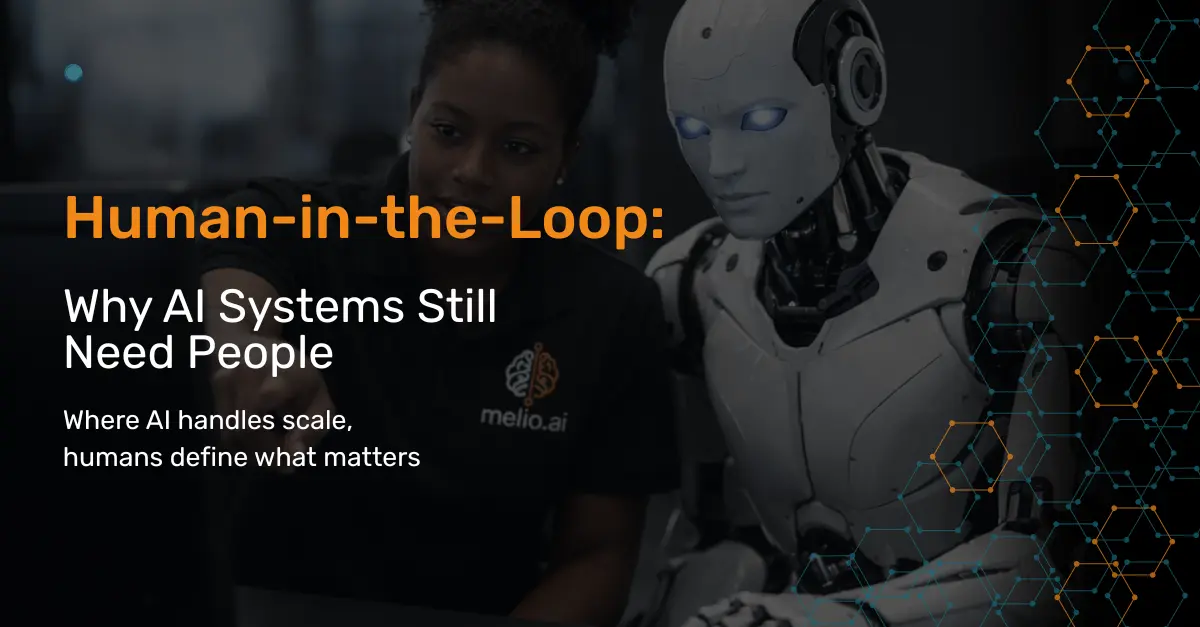
Everyone talks about automation: faster decisions, lower costs, less manual work. In controlled demos, that promise usually holds up. In production, it tends to break down, and not because the models are weak, but because the environments they operate in are messier and more unpredictable than any demo ever captures.
This is where Human-in-the-Loop (HITL) becomes essential.
What Human-in-the-Loop Actually Means
Human-in-the-Loop is widely misunderstood as a fallback, something you bolt on after the system starts misbehaving. That framing gets it exactly backwards.
HITL is a design decision, one you make upfront, about where humans should sit in the system and where they should not. A well-designed system lets AI handle repeatable work, brings humans in where judgment, context or risk matters, and uses that human input to improve the system over time.
When it works, the humans are not a bottleneck; they are what makes the whole thing trustworthy enough to run in the real world.
Why Fully Automated AI Fails in Practice
Full automation is an appealing idea, but it rarely holds in practice, not because it is technically impossible, but because it assumes a level of consistency in real-world environments that simply does not exist. A few patterns tend to surface quickly once a system goes live.
1. Messy inputs
Real-world data is incomplete, inconsistently formatted, and full of edge cases that never appeared in testing. A pipeline that worked flawlessly in a controlled environment can start drifting within days of launch as the inputs it was never designed for begin arriving in volume.
2. Confident but wrong outputs
Unlike a human who hesitates when uncertain, AI produces outputs that look authoritative regardless of whether they are correct. That makes failures much harder to catch; the system does not break in an obvious way, it just quietly produces plausible-looking errors that pass through unchecked.
3. Errors that compound over time
Small problems at the start of a workflow rarely stay small. A misclassification here, a missed flag there; these surface weeks later as incorrect approvals, compliance gaps, or customer complaints.
When that starts happening repeatedly, teams lose confidence in the system and quietly fall back to doing things manually, leaving you with infrastructure that is technically running but no longer trusted.
Where Humans Actually Fit
The systems that hold up reliably in production are not the ones that removed humans; they are the ones that placed humans deliberately. Most of them follow a similar arc, and understanding it matters more than trying to skip ahead:
- Heavily involved early: people shape how the system behaves and calibrate what “good” looks like before trusting it with anything consequential
- Selective review: as the system proves itself, humans shift from guiding decisions to reviewing outputs before they are finalised
- Exception handling: confidence grows in lower-risk areas, so humans step back and only engage when something falls outside expected bounds
- Full automation: in a small number of tightly controlled cases, the system has earned enough trust to run without human sign-off
The point is not to reach step four as quickly as possible. It is to reduce risk incrementally while building the trust that makes each step forward safe.
A More Practical Way to Think About It
Rather than thinking about maturity levels or percentages of automation, the more useful questions are: where are mistakes most likely to happen, where would those mistakes have real impact, and where does a human’s involvement actually change the outcome? The answers vary by domain, but the logic is consistent:
- Claims processing: human review wherever fraud risk is elevated, not across the board
- Customer support: human handoff when intent is ambiguous or the situation is emotionally sensitive
- Document workflows: routing cases with missing or contradictory data rather than letting the model guess through them
The underlying pattern is consistent across all of them:
🤖 AI handles scale, humans handle judgment. 🙆
The Shift: Humans Above the Loop
Beyond where humans sit within individual workflows, there is a broader structural shift underway.
Increasingly, humans are not just participants in the loop; they are the ones setting the rules that govern it: They decide what confidence threshold is required before the system acts autonomously, which categories of case must always pass through a reviewer, and under what conditions escalation should trigger.
The AI operates within those parameters; the parameters themselves are a human decision.
🌟 This means accountability stays where it belongs: with the business, not with the model.
Designing Systems That Actually Work
The systems that stay reliable over time tend to share a few key traits:
Transparency: They make it clear what is automated and what isn’t, so the humans involved always know where they stand.
Smart Routing: They send only the right cases for human review, enough to catch meaningful issues, but not so many that reviewers end up rubber-stamping just to keep up.
Feedback Loops: Every human correction, override, or escalation is treated as a valuable signal and is fed back into the system to make the next decision a little better.
Without that continuing human feedback, these systems don’t usually fail in dramatic ways; instead, they slowly become less useful as the world changes and the system drifts away from what it originally understood.
The Real Trade-off
Speed and control always exist in tension. More automation gives you more throughput; more human involvement gives you more accuracy and accountability. Trying to push too hard on one tends to compromise the other, which is why the goal should never be framed as “maximum automation.”
The more honest objective is reliable automation, being deliberate about which parts of a workflow are ready to run without human oversight, and equally deliberate about which parts are not.
Final Thought
The question that leads teams astray is “where can we remove humans?”, treating human involvement as a cost to be minimised rather than a capability to be deployed well.
The better question is “where does human judgment actually change the outcome?” Starting from there usually means using people heavily in the early stages when the system is still being shaped, keeping them close to the decisions where context and stakes are highest, pulling them back as confidence is earned in lower-risk areas, and reserving full automation for the places where the system has proven itself.
That is the pattern behind AI deployments that actually hold up in production, not the ones that tried to remove humans, but the ones that figured out where humans belong.