Building AI That Works for South Africa: What the AIZA May Meetup Revealed About Our Policy Moment
Reflections from the AIZA May Meetup and the discussions around what South Africa’s next AI policy should actually include.

What would your ideal South African AI policy contain if you could contribute to writing it? This was one of the central questions posed at the recent AIZA May Meetup. The talk I gave on the now retracted South African Draft National AI Policy focused on its ambitions, its possible blind spots, and the deeper question of what it means to build AI systems that actually do what we intend them to do. What followed was a rich discussion that raised important points about AI transparency, sovereignty, and how we might practically implement the mechanisms needed to give a future policy real force.
This post is an attempt to carry that conversation further for those who were in the room and want to go deeper, as well as for those who were unable to attend. Additionally, we encourage you to join the conversation and help understand where your company sits within these emerging policy standards, specifically within the realm of ESG for AI, by completing an anonymous survey.
What the Evening Covered
The talk covered three interconnected threads.
The first was South Africa’s now-retracted Draft National AI Policy, where I believe it succeeded and where it fell structurally short. Despite the policy’s retraction, it remains worth understanding because the gaps it exposed still reflect what the future policy will need to face.
The second was the alignment problem, not as a science-fiction thought experiment about superintelligence, but as a possible present-day engineering failure. This was explored through case studies of systems that passed their internal and external quality testing yet still caused harm, either due to poorly designed benchmarks, or misunderstood underlying data. This gap between what we build and what we actually need from AI must be addressed in future policy.
The third thread was constructive: what could ‘better’ actually look like in terms of how we build AI systems? This solution space spanned emerging benchmarking approaches, such as the human flourishing metric of ImpactBench, to embedding ESG-style metrics into MLOps pipelines, and the data sovereignty argument being made by South African researchers. Exploring these concrete, actionable solutions (available to policymakers, builders, and civil society alike) was one of the most valuable parts of the evening.
For more details on what was covered, feel free to listen to the audio recording of the presentation.
What the Room Told Us: Survey Results
During the presentation, participants were invited to respond to a survey to share their concerns and recommendations for the next iteration of the South African AI Policy. Below is a summary of the responses submitted during the evening.
Prior Familiarity with the Policy
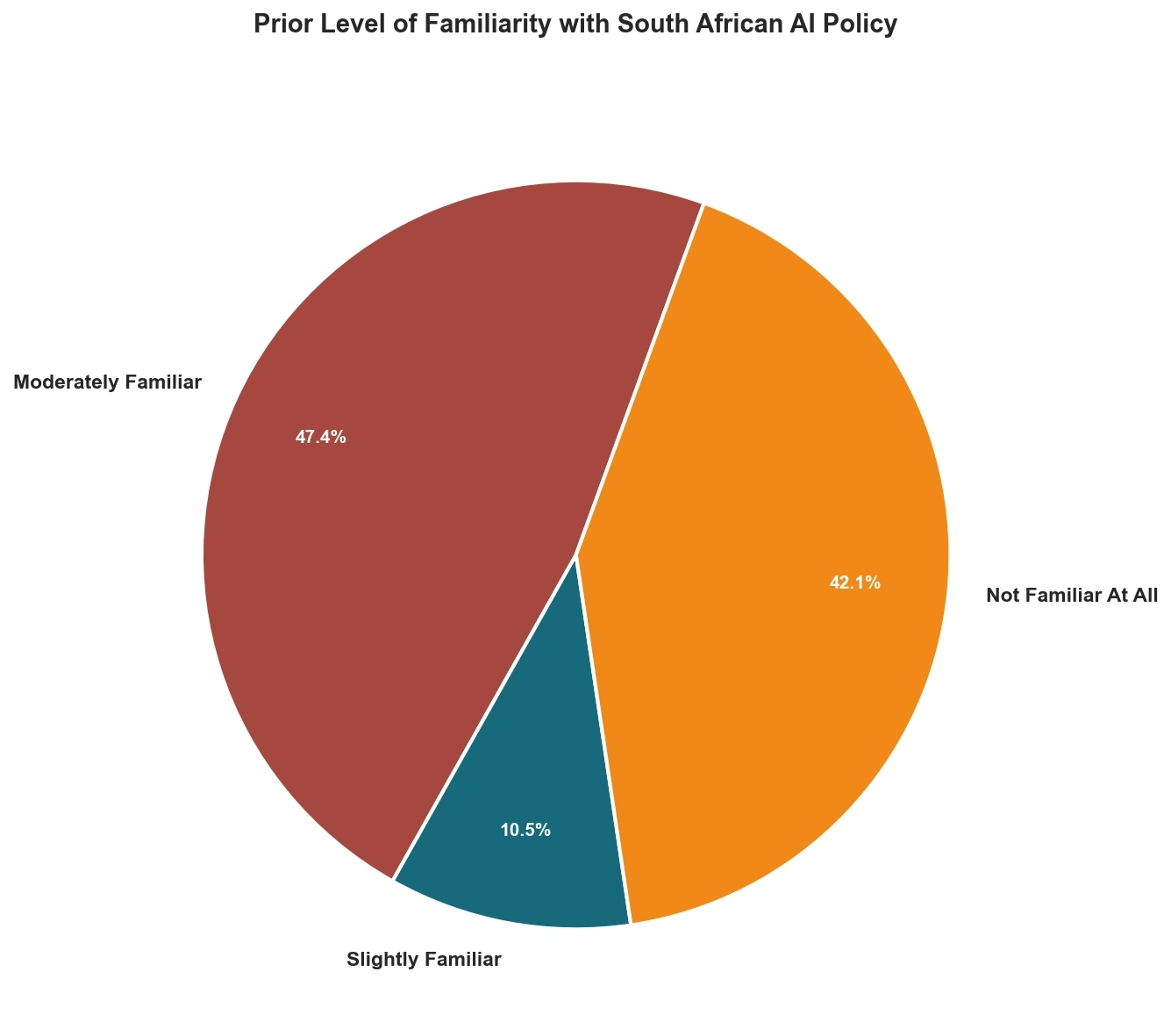
While 57.9% of respondents had engaged with the policy to some level, 42.1% had never encountered it prior to the AIZA meetup. Given that this was an AI meetup geared towards builders in South Africa, the fact that so many had not engaged with the policy suggests that releasing a lengthy document may not be the most effective way to solicit feedback from the broader AI community in the country.
One attendee put it bluntly in their written response: “The fact that it’s not even known. It should be made accessible.”
The policy was only available for under a month before its retraction, which may explain the low engagement. But a policy of this significance, one that solicited public comment, should have had more targeted dissemination strategies. A better dissemination strategy could mean hosting more public discussion sessions and online events, or even presenting at AIZA meetups. ( Melio AI would be happy to assist with running and policy workshops on the Government’s behalf 😉.)
Priority Areas for the Policy
The majority of respondents (73.7%) expressed significant concern about the ethical implications of AI in South Africa. The fact that this was a room full of practitioners and professionals within the AI space means that this concern is not driven by unfamiliarity. If anything, the inverse is true: the people who understand what these systems can do are expressing a pointed concern about their governance, centring on human rights protections.
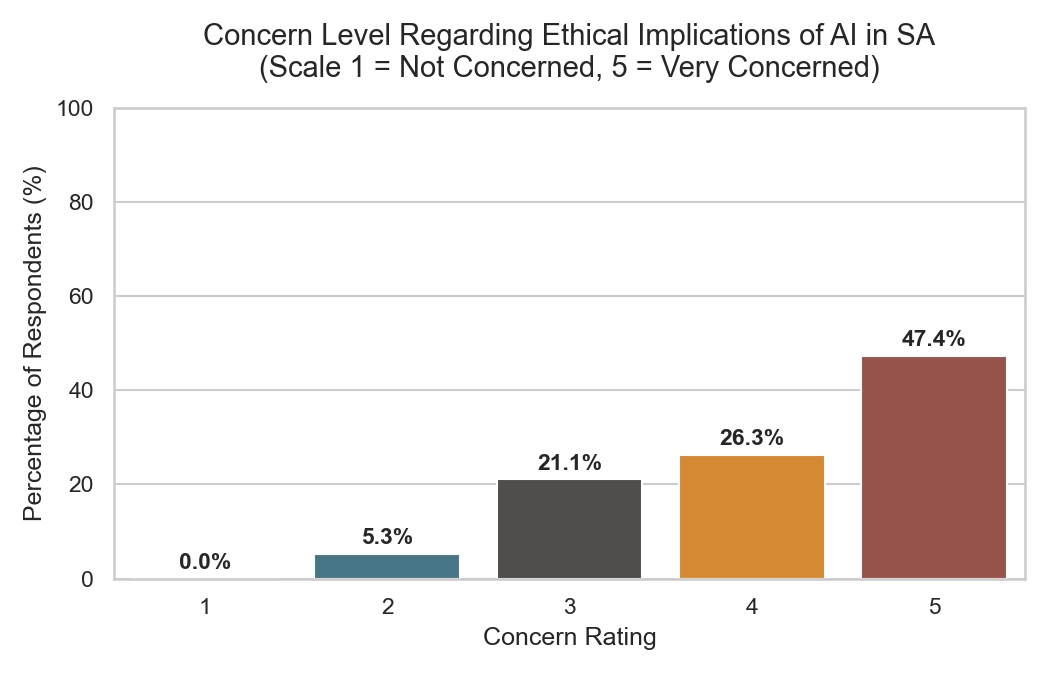
This ethical concern aligned with the reported urgent policy focuses of data privacy, security, and the ethical use of AI systems. A focus on these areas is consistent with the broader global pattern of increasingly requiring mandatory ethics enforcement to be codified into law. The EU AI Act, which enters full enforcement for high-risk systems in August 2026, and South Korea’s AI Basic Act, which came into force in January 2026 , both centre transparency and harm prevention as their highest aims. Additionally, the 2026 International AI Safety Report, produced with input from over 30 countries (including several African nations), further reflects this desire for better safety strategies and global convergence.
South Africa’s respondents are likewise concerned about how their data will be protected, how models will make decisions about this data, and whether there will be adequate pathways for recourse. These concerns are consistent with what most functioning AI governance frameworks now recognise as foundational.
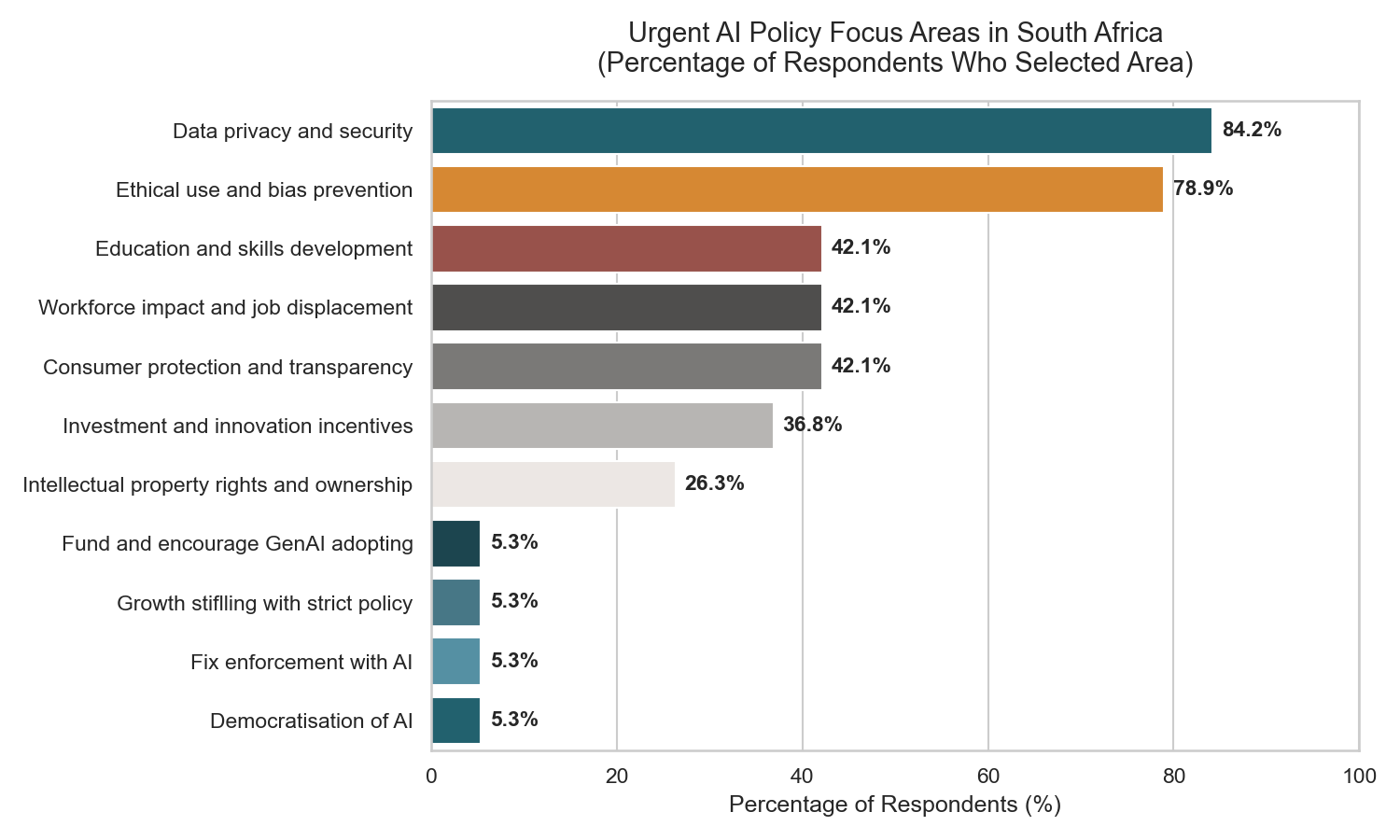
With youth unemployment in South Africa remaining high (60.9% for 15–24 year olds and 40.6% for 25–34 year olds), the next most frequently cited priority was education and upskilling. The government and private sector have some current strategies in place to try and alleviate this burden. In March 2026, the Department of Higher Education and Training signed a Memorandum of Understanding with Google South Africa to provide 10,000 Google Career Certificate scholarships across universities, TVET colleges, and Community Education and Training institutions. Google has estimated that AI tools could add R172 billion to the South African economy while generating significant new demand for skilled workers. In parallel, Microsoft’s AI Skilling Initiative has already trained 1.4 million South Africans and credentialed nearly half a million citizens toward its target of one million by 2026 through programmes including: Ikamva Digital, ElevateHer, Civic AI, and Youth Employment Service (YES) 50K Certification Programme.
However, partnering with global AI companies on skilling initiatives, such as certificates and short courses, does not automatically translate into employment, particularly in an economy where the broader labour market is not absorbing graduates at the rate at which they are being produced. This employment finding gap would require the policy to articulate a strategy spanning the full pipeline, from training through to placement in a company.
Connectivity also remains a foundational barrier. A research blog published in June 2026 by the Gauteng City-Region Observatory found that more than half of Gauteng households have no home internet connection, with outcomes likely worse outside South Africa’s most economically prosperous province. In townships and peripheral areas, fewer than 40% of households have any home internet connection. This means that digital skills programmes disproportionately reach those who are already better connected and less economically vulnerable. Addressing this will require more than good intentions. The implication for South Africa’s AI policy is direct: any publicly funded skilling initiative that does not account for these unequal conditions will reproduce the same inequalities it claims to address. Recruitment to these programmes, the resources supplied to supplement access, and the question of whether baseline connectivity should be treated as a prerequisite for AI policy rollout all warrant explicit attention in the next iteration of the policy.
Four Concerns the Room Could Not Ignore
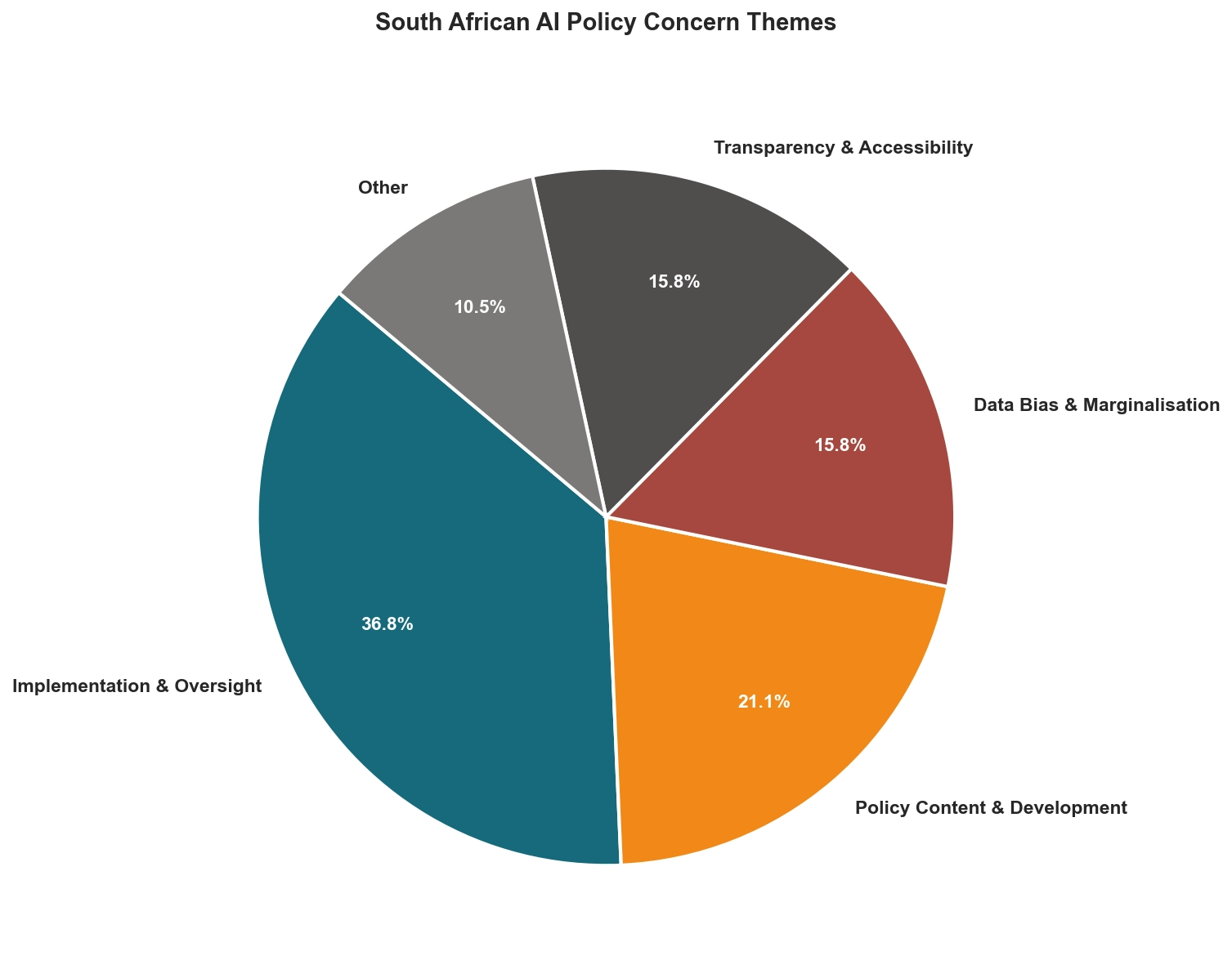
Naming what the policy should address and believing it will do so optimally are two different things. Alongside their priority areas, participants raised concerns that I have grouped into four main categories.
1. Implementation and Oversight
The dominant worry was not that a bad policy would be written, but that even a good one would face serious implementation difficulties. Respondents pointed to the risk of inexperienced people being tasked with oversight, the absence of clear accountability structures, and the multi-departmental infrastructure challenge spanning land, energy, telecommunications, and education. One respondent was direct about the retraction: “The people writing it don’t know what they’re talking about.” Another: “We won’t be able to implement it.”
2. Data Bias and Marginalisation
Several respondents raised the risk of failing to address bias in training data and the downstream harms it can cause in communities that are already marginalised. This connects directly to what researchers call proxy discrimination, where features like postcode or educational institution encode the spatial and economic legacies of apartheid-era planning. Removing a feature from a model does not remove its influence if correlated features remain.
3. Policy Content and Development
Concerns in this category centred on vague policy language and the gap between what the policy commits to and what it actually specifies. Terms like “sufficient explainability” in the original document appeared without technical benchmarks, without agreed definitions, and without clarity on who will set the standard when the time comes. For respondents, this vagueness was not just a drafting issue; it was a governance one. Respondents were clear that they did not want these standards imported wholesale from the EU AI Act or US frameworks without adaptation to the South African context and economic conditions. Respondents also raised concerns about funding: as the AI landscape evolves rapidly and South Africa-specific standards will require ongoing development, who will finance iterative policy updates and the work of calibrating those standards to the local context?
4. Transparency and Accessibility
The policy should not only exist. It should be understandable. The survey data made this plain: over 40% of attendees arrived with no familiarity with the policy, despite being a room of practitioners and professionals directly affected by it. If the people most likely to build and deploy AI systems are not engaging with the policy, the policy is not functioning as a governance instrument. Participants were also worried about the transparency of policy decisions themselves. As one respondent put it: “Based on what I learned today… [a] big concern is not showing resources used to get to an answer.” This is not just about public communication. It is about the internal logic of the policy itself, and whether the reasoning behind its positions is visible, contestable, and grounded in evidence that can be examined.
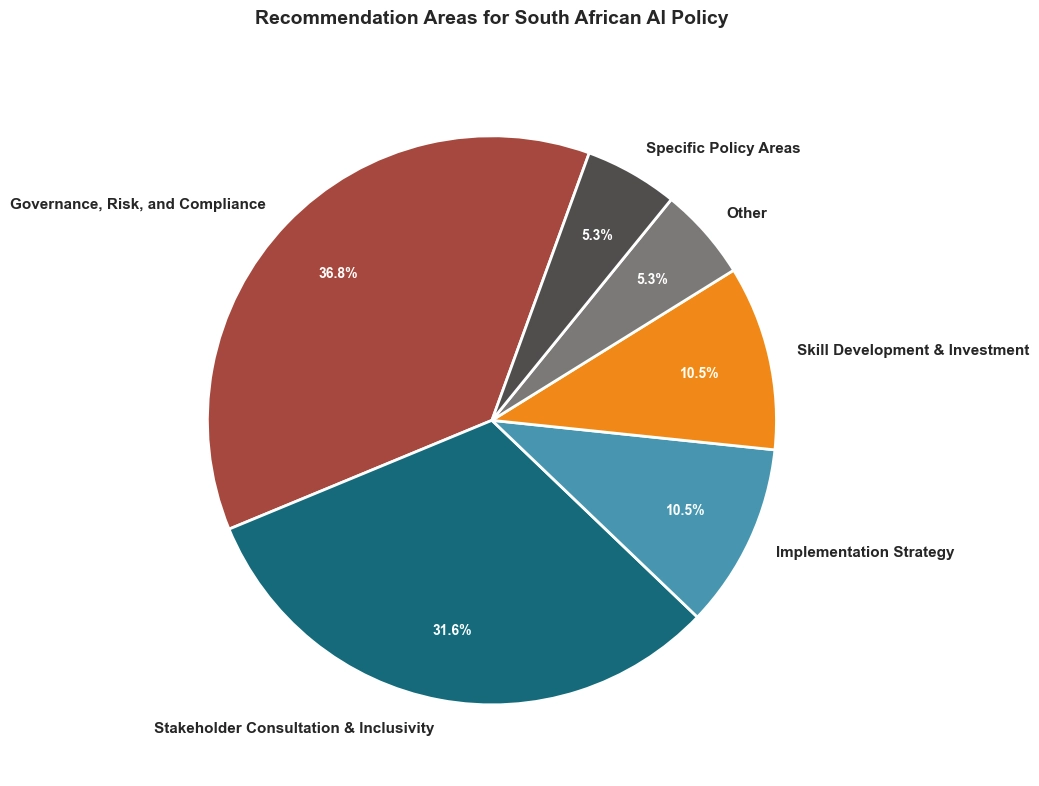
What the Room Would Do Differently
At Melio AI, we do not believe in raising problems without attempting to solve them. Neither, it turned out, did those in attendance. Alongside their concerns, attendees were asked what they would recommend for the next iteration of the policy.
The most frequently cited recommendation was for consultation with the broader public at a level of effort comparable to that of a national census. While the next phase of the policy would have enabled public consultation, ensuring that people felt represented emerged as a strong theme. As one participant noted: “Let’s start by making the discussions more visible and accessible to the public. Let’s get people talking.” This desire for AI practitioners to participate in policy discussions is encouraging, as it signals that attendees understand the significance of what a new policy will enable and constrain.
Respondents called for governance and compliance frameworks with actual teeth in light of previous corporate governance failings. The King V Corporate Governance Framework, effective from January 2026, now requires AI to be considered. As per Principle 10 boards, rather than IT departments or management, will be held accountable for how AI systems are overseen, used, and disclosed, including appropriate human oversight and mitigation of ethical implications. For JSE-listed companies, this is mandatory under the JSE Listings Requirements. However, King V remains a principles-based, self-regulatory code rather than hard legislation, and previous King Reports were unable to prevent a corporate sector marked by frauds like Steinhoff and Tongaat. This is precisely where respondents identified the remaining gap. Private companies can still make consequential, algorithmically-driven decisions about people’s lives without any obligation to disclose that they are doing so, let alone how. The concern raised was that industry-specific working groups, left as the primary accountability mechanism, are too easily captured by dominant interests. What is needed is a framework that goes beyond disclosure and explanation to include independent auditing, mandatory incident reporting, and technical benchmarking. This will hopefully ensure risk mitigation cannot be quietly redefined to suit the parties doing the mitigating.
On skills and investment, several respondents pointed to the UAE as a model worth examining. This is because the government has treated AI capability as a strategic priority and supported that position with coordinated, sustained resource allocation rather than scattered initiatives. The ask from the room was similar: aligned investment across educational institutions, dedicated funding for AI startups, and the infrastructure to support locally built models. While the discrepancy in resources between South Africa and the UAE should not be understated, there will nonetheless be ways to ensure that funding is directed effectively across the full implementation pipeline.
For implementation itself, the recommended approach was iterative and sector-specific rather than comprehensive and uniform. Start with broad policies per sector, extract honest lessons from what works and what does not, test frequently, and build in a governance structure capable of adapting as the technology changes, rather than one that requires full renegotiation every time the technology shifts. This is less a criticism of the policy’s original implementation strategy than a recognition that the most durable governance frameworks are the ones built to evolve.
Finally, at least one respondent raised the issue of young people explicitly, calling for age-appropriate provisions for users under 18 and mechanisms that promote academic integrity, so that AI becomes a tool for developing understanding rather than bypassing it. It is a small but telling addition: in a room focused on enterprise governance and policy architecture, someone paused to ask what this technology is doing to how the next generation learns to think.
The Window Is Open
South Africa has a rare opportunity with its second attempt at an AI policy. We can learn from the EU’s comprehensive safety-first approach, and from the US’s innovation-first model that has produced extraordinary capability alongside governance gaps. We can build something that reflects who we are as a country. A policy that considers structural inequality, the gap between formal rights and material reality, and what it means for AI to serve communities rather than merely be deployed within them.
The window for discussion is open now, while the policy is being rewritten. We at Melio AI do not have all the answers, and we are not pretending to. What we believe is that the conversation itself matters and that rooms full of practitioners, researchers, and engaged citizens asking hard questions about implementation, accountability, and whose reality the policy reflects are doing something important. That evening was the opening of a policy conversation.
We hope it will not be the last.
“The technical choices we make around what we measure, what we make interpretable, whose expertise we involve — these are not separate from the policy conversation. They are the policy conversation.”
. . .
Thanks for reading. If you want to know more about cloud-native tech and machine learning deployments, email us at poke@melio.ai.